Lesson 19: Two Mean T-Test
Lesson Administration
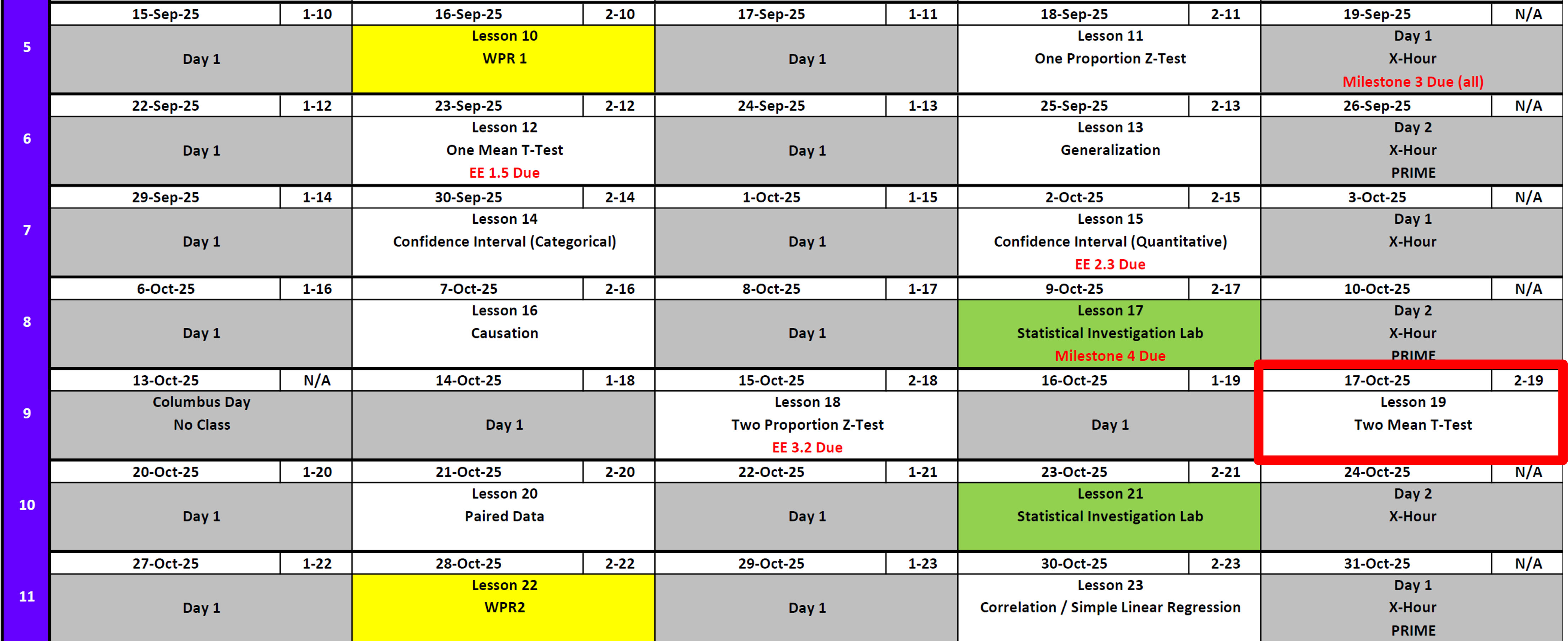
Calendar
Day 1
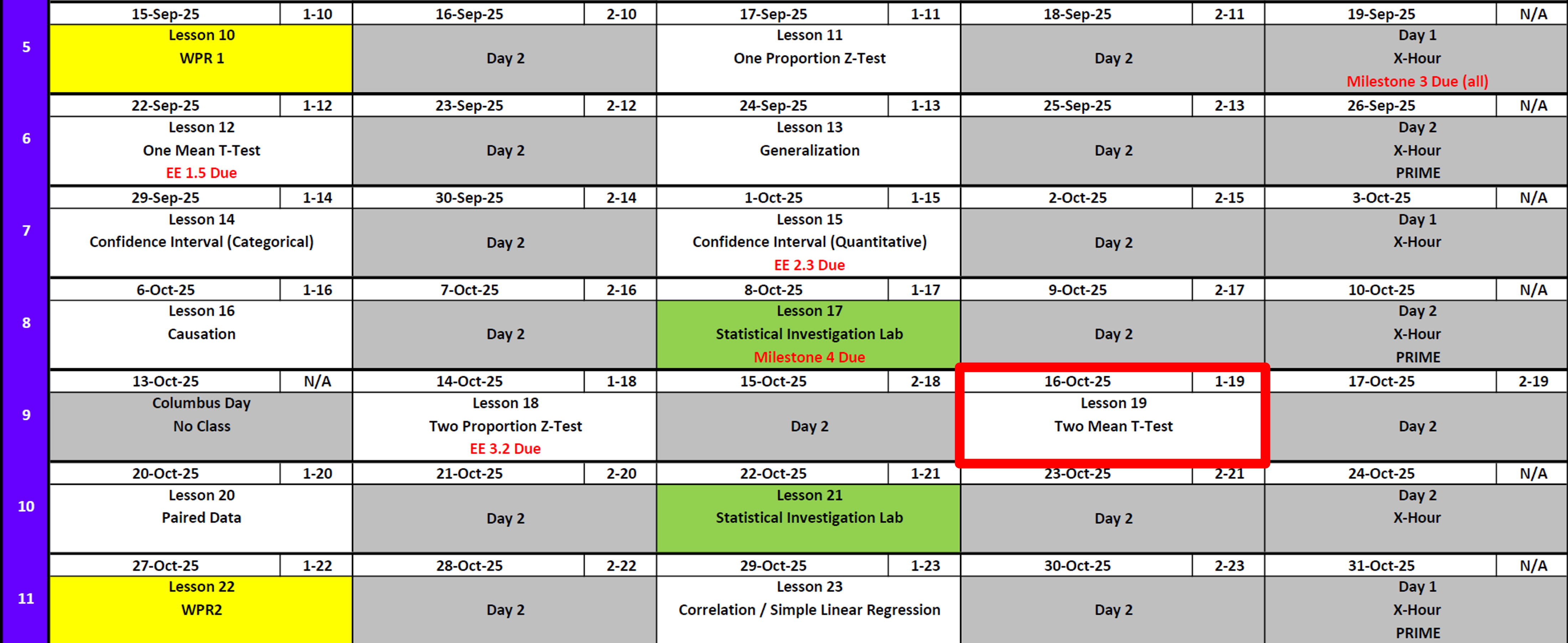
Day 2
SIL 1 (Redeployment)
- What it means for you depending on how you feel about it
Exploration Exercise 3.2 (Next Lesson - HARD COPY!!)
- ⏰ Due on Lesson 19 (Today)
- Day 1: Tuesday, 16 Oct 2025
- Day 2: Wednesday, 17 Oct 2025
Exploration Exercise 7.2
- Canvas Quiz Due 21 OCT at Midnight
SIL 2
- Details
- Shorter version of last time with in class feedback time
WPR 2
Milestone 5
- Due 0700 on 7 November
- Instructions
DMath Frisbee PLAYOFFS!!
Math 1 vs DPE
NotePreviously 5-0
6-0

Army Math






Cal







Running Review
Review: \(z\)-Tests for One Proportion
For all cases:
\(H_0:\ \pi = \pi_0\)
\[ z = \frac{\hat{p} - \pi_0}{\sqrt{\frac{\hat{p}\,(1-\hat{p})}{n}}} \]
| Alternative Hypothesis | Formula for \(p\)-value | R Code |
|---|---|---|
| \(H_A:\ \pi > \pi_0\) | \(p = 1 - \Phi(z)\) | p_val <- 1 - pnorm(z_stat) |
| \(H_A:\ \pi < \pi_0\) | \(p = \Phi(z)\) | p_val <- pnorm(z_stat) |
| \(H_A:\ \pi \neq \pi_0\) | \(p = 2 \cdot (1 - \Phi(|z|))\) | p_val <- 2 * (1 - pnorm(abs(z_stat))) |
Where:
- \(\hat{p} = R/n\) (sample proportion)
- \(\pi_0\) = hypothesized proportion under \(H_0\)
- \(\Phi(\cdot)\) = cumulative distribution function (CDF) of the standard normal distribution
Validity Conditions
- Number of successes and failures must be greater than 10.
Confidence Interval for \(\pi\) (one proportion)
\[ \hat{p} \;\pm\; z_{\,1-\alpha/2}\,\sqrt{\frac{\hat{p}\,(1-\hat{p})}{n}} \]
I am \((1 - \alpha)\%\) confident that the true population proportion \(\pi\) lies between \([\text{lower bound}, \text{upper bound}]\).
Review: \(t\)-Tests for One Mean
For all cases:
\(H_0:\ \mu = \mu_0\)
\[ t = \frac{\bar{x} - \mu_0}{s / \sqrt{n}} \]
| Alternative Hypothesis | Formula for \(p\)-value | R Code |
|---|---|---|
| \(H_A:\ \mu > \mu_0\) | \(p = 1 - F_{t,df}(t)\) | p_val <- 1 - pt(t_stat, df) |
| \(H_A:\ \mu < \mu_0\) | \(p = F_{t,df}(t)\) | p_val <- pt(t_stat, df) |
| \(H_A:\ \mu \neq \mu_0\) | \(p = 2 \cdot (1 - F_{t,df}(|t|))\) | p_val <- 2 * (1 - pt(abs(t_stat), df)) |
Where:
- \(\bar{x}\) = sample mean
- \(\mu_0\) = hypothesized mean under \(H_0\)
- \(s\) = sample standard deviation
- \(n\) = sample size
- \(df = n - 1\) (degrees of freedom)
- \(F_{t,df}(\cdot)\) = CDF of Student’s \(t\) distribution with \(df\) degrees of freedom
Validity Conditions
- Sample size must be greater than 30.
Confidence Interval for \(\mu\) (one mean)
\[ \bar{x} \;\pm\; t_{\,1-\alpha/2,\;df}\,\frac{s}{\sqrt{n}}, \qquad df = n-1 \] I am \((1 - \alpha)\%\) confident that the true population mean \((\mu)\) lies between \([\text{lower bound}, \text{upper bound}]\).
Review: \(z\)-Tests for Two Proportions
For all cases:
\(H_0:\ \pi_1 - \pi_2 = 0\)
\[ z \;=\; \frac{(\hat{p}_1 - \hat{p}_2) - (\pi_1 - \pi_2)}{\sqrt{\hat{p}(1-\hat{p})\left(\tfrac{1}{n_1} + \tfrac{1}{n_2}\right)}} \]
Where the pooled proportion is
\[ \hat{p} \;=\; \frac{x_1 + x_2}{n_1 + n_2}. \]
| Alternative Hypothesis | Formula for \(p\)-value | R Code |
|---|---|---|
| \(H_A:\ \pi_1 - \pi_2 > 0\) | \(p = 1 - \Phi(z)\) | p_val <- 1 - pnorm(z_stat) |
| \(H_A:\ \pi_1 - \pi_2 < 0\) | \(p = \Phi(z)\) | p_val <- pnorm(z_stat) |
| \(H_A:\ \pi_1 - \pi_2 \neq 0\) | \(p = 2 \cdot (1 - \Phi(|z|))\) | p_val <- 2 * (1 - pnorm(abs(z_stat))) |
Where:
- \(\hat{p}_1 = x_1/n_1\) (sample proportion in group 1)
- \(\hat{p}_2 = x_2/n_2\) (sample proportion in group 2)
- \(\pi_1, \pi_2\) = hypothesized proportions under \(H_0\)
- \(\Phi(\cdot)\) = cumulative distribution function (CDF) of the standard normal distribution
Validity Conditions
- Each group must have at least 10 successes and 10 failures.
Confidence Interval for \(\pi_1 - \pi_2\) (unpooled SE)
\[ (\hat{p}_1 - \hat{p}_2) \;\pm\; z_{\,1-\alpha/2}\, \sqrt{\tfrac{\hat{p}_1(1-\hat{p}_1)}{n_1} + \tfrac{\hat{p}_2(1-\hat{p}_2)}{n_2}} \]
I am \((1 - \alpha)\%\) confident that the true difference in population proportions \((\pi_1 - \pi_2)\) lies between \([\text{lower bound}, \text{upper bound}]\).
Interpreting the \(p\)-value
Rejecting \(H_0\)
> Since the \(p\)-value is less than \(\alpha\) (e.g., \(0.05\)), we reject the null hypothesis.
> We conclude that there is sufficient evidence to suggest that [state the alternative claim in context].Failing to Reject \(H_0\)
> Since the \(p\)-value is greater than \(\alpha\) (e.g., \(0.05\)), we fail to reject the null hypothesis.
> We conclude that there is not sufficient evidence to suggest that [state the alternative claim in context].Strength of evidence: Smaller \(p\) means stronger evidence against \(H_0\).
Other Notes
- Generalization: We can generalize results to a larger population if the data come from a random and representative sample of that population.
- Causation: We can claim causation if participants are randomly assigned to treatments in an experiment. Without random assignment, we can only conclude association, not causation.
\[ \begin{array}{|c|c|c|} \hline & \text{Randomly Sampled} & \text{Not Randomly Sampled} \\ \hline \textbf{Randomly Assigned} & \begin{array}{c} \text{Generalize: Yes} \\ \text{Causation: Yes} \end{array} & \begin{array}{c} \text{Generalize: No} \\ \text{Causation: Yes} \end{array} \\ \hline \textbf{Not Randomly Assigned} & \begin{array}{c} \text{Generalize: Yes} \\ \text{Causation: No} \end{array} & \begin{array}{c} \text{Generalize: No} \\ \text{Causation: No} \end{array} \\ \hline \end{array} \]
- Parameters vs. Statistics: A parameter is a fixed (but usually unknown) numerical value describing a population (e.g., \(\mu\), \(\sigma\), \(\pi\)). A statistic is a numerical value computed from a sample (e.g., \(\bar{x}\), \(s\), \(\hat{p}\)).
- Parameters = target (what we want to know).
- Statistics = evidence (what we can actually measure).
- We use statistics to estimate parameters, and because different samples give different statistics, we capture this variability with confidence intervals.
- Parameters = target (what we want to know).
| Quantity | Population (Parameter) | Sample (Statistic) |
|---|---|---|
| Center (mean) | \(\mu\) | \(\bar{x}\) |
| Spread (SD) | \(\sigma\) | \(s\) |
| Proportion “success” | \(\pi\) | \(\hat{p}\) |
Two Mean \(t\)-Test
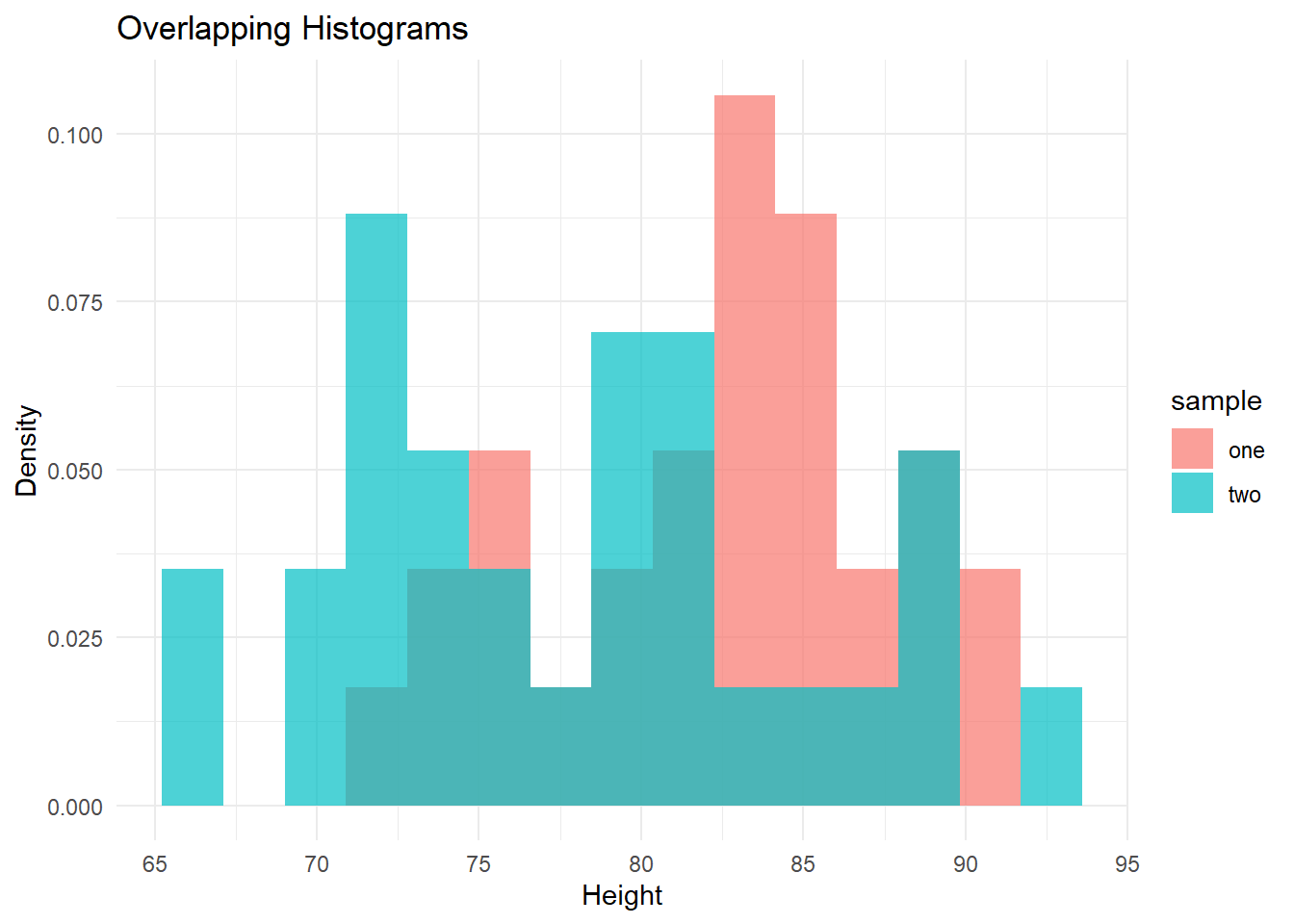
Researchers at West Point are interested in whether cadets who study in groups score higher on a quiz than cadets who study alone.
- Group study: \(n_1 = 15\), \(\bar{x}_1 = 82.4\), \(s_1 = 5.6\)
- Study alone: \(n_2 = 12\), \(\bar{x}_2 = 78.1\), \(s_2 = 6.3\)
Question: Is the mean score for group study greater than for studying alone?
Step 1: Hypotheses
Null:
\(H_0:\ \mu_1 - \mu_2 = 0\)Alternative (one-sided):
\(H_A:\ \mu_1 - \mu_2 > 0\)
Where:
- \(\mu_1\) = mean score for group study
- \(\mu_2\) = mean score for study alone
Step 2: Test Statistic
The two-sample \(t\)-test:
\[ t \;=\; \frac{(\bar{x}_1 - \bar{x}_2) - 0}{\sqrt{\tfrac{s_1^2}{n_1} + \tfrac{s_2^2}{n_2}}} \]
Degrees of freedom
\[ df = n_1 + n_2 - 2 \]
Step 3: Compute
\[ \begin{aligned} t &= \frac{(\bar{x}_1 - \bar{x}_2) - 0}{\sqrt{\tfrac{s_1^2}{n_1} + \tfrac{s_2^2}{n_2}}} \\[6pt] &= \frac{82.4 - 78.1}{\sqrt{\tfrac{5.6^2}{15} + \tfrac{6.3^2}{12}}} \\[6pt] &= \frac{4.3}{2.32} \\[6pt] &\approx 1.85, \\[6pt] \end{aligned} \]
\[ df = 15 + 12 - 2 = 25 \]
xbar1 <- 82.4; s1 <- 5.6; n1 <- 15
xbar2 <- 78.1; s2 <- 6.3; n2 <- 12

SE <- sqrt(s1^2/n1 + s2^2/n2)
t_stat <- (xbar1 - xbar2)/SE

df <- n1 + n2 - 2

p_val <- 1 - pt(t_stat, df)
list(t_stat = t_stat, df = df, p_val = p_val)
$t_stat
[1] 1.85074
$df
[1] 25
$p_val
[1] 0.03802918Step 4: Decision
Since \(p \approx 0.038 < 0.05\), we reject \(H_0\).
There is significant evidence that cadets who study in groups score higher on average.
Step 5: Confidence Interval
95% CI for \(\mu_1 - \mu_2\):
\[ (\bar{x}_1 - \bar{x}_2) \;\pm\; t_{0.975,\,df}\, \sqrt{\tfrac{s_1^2}{n_1} + \tfrac{s_2^2}{n_2}} \]
\[ \begin{aligned} &= 4.3 \;\pm\; (2.06)\sqrt{\tfrac{5.6^2}{15} + \tfrac{6.3^2}{12}} \\[6pt] &= 4.3 \;\pm\; (2.06)(2.32) \\[6pt] &= 4.3 \;\pm\; 4.78 \\[6pt] &= (-0.48,\; 9.08), \qquad df = 25 \end{aligned} \]
xbar1 <- 82.4; s1 <- 5.6; n1 <- 15
xbar2 <- 78.1; s2 <- 6.3; n2 <- 12

SE <- sqrt(s1^2/n1 + s2^2/n2)
df <- 25
tcrit <- qt(0.975, df)

diff <- xbar1 - xbar2
CI <- diff + c(-1,1) * tcrit * SE

list(diff = diff, SE = SE, tcrit = tcrit, CI = CI, df = df)
$diff
[1] 4.3
$SE
[1] 2.323396
$tcrit
[1] 2.059539
$CI
[1] -0.4851226 9.0851226
$df
[1] 25We are 95% confident that group study increases quiz scores by between –0.4 and 9 points (on average).
Validity & Scope
- Validity: Groups are independent and \(n_1,n_2\) are moderately large.
- Scope:
- Random sampling \(\;\rightarrow\;\) generalize to cadets.
- Random assignment \(\;\rightarrow\;\) claim causation.
- Random sampling \(\;\rightarrow\;\) generalize to cadets.
Example: Difference in Heights
Researchers sampled adult heights (in inches):
- Men: \(n_1 = 30,\;\bar{x}_1 = 69.8,\; s_1 = 2.9\)
- Women: \(n_2 = 28,\;\bar{x}_2 = 65.0,\; s_2 = 2.7\)
We wish to test whether the true mean difference is less than 5.5 inches.
Step 1: Hypotheses
\[ H_0:\ \mu_1 - \mu_2 = 5.5 \qquad\text{vs}\qquad H_A:\ \mu_1 - \mu_2 < 5.5 \]
where \(\mu_1\) = mean male height, \(\mu_2\) = mean female height.
Step 2: Test Statistic
\[ \begin{aligned} t &= \frac{(\bar{x}_1 - \bar{x}_2) - 5.5}{\sqrt{\tfrac{s_1^2}{n_1} + \tfrac{s_2^2}{n_2}}} \\[6pt] &= \frac{69.8 - 65.0 - 5.5}{\sqrt{\tfrac{2.9^2}{30} + \tfrac{2.7^2}{28}}} \\[6pt] &= \frac{4.8 - 5.5}{0.735} \\[6pt] &\approx -0.95, \qquad df \approx 56 \end{aligned} \]
xbar1 <- 69.8; s1 <- 2.9; n1 <- 30   # men
xbar2 <- 65.0; s2 <- 2.7; n2 <- 28   # women

diff <- xbar1 - xbar2
SE   <- sqrt(s1^2/n1 + s2^2/n2)

# Welch-Satterthwaite degrees of freedom
df <- n1 + n2 - 2

# Hypothesized difference = 5.5
t_stat <- (diff - 5.5)/SE
p_val  <- pt(t_stat, df)   # one-sided, "<"

list(t_stat = t_stat, df = df, p_val = p_val)
$t_stat
[1] -0.9519709
$df
[1] 56
$p_val
[1] 0.1726013Step 3: Decision
One-sided \(p\)-value \(\approx 0.17\).
At \(\alpha=0.05\), we fail to reject \(H_0\).
The evidence is not strong enough to conclude that the mean difference is less than 5.5 inches.
Step 4: 95% Confidence Interval
\[ \begin{aligned} (\bar{x}_1 - \bar{x}_2) \;\pm\; t_{0.975,\,df}\, \sqrt{\tfrac{s_1^2}{n_1} + \tfrac{s_2^2}{n_2}} &= 4.8 \;\pm\; (2.00)(0.735) \\[6pt] &= 4.8 \;\pm\; 1.47 \\[6pt] &= (3.33,\; 6.27) \end{aligned} \]
tcrit <- qt(0.975, df)
CI95  <- diff + c(-1, 1) * tcrit * SE

list(diff = diff, SE = SE, tcrit = tcrit, CI95 = CI95, df = df)
$diff
[1] 4.8
$SE
[1] 0.7353166
$tcrit
[1] 2.003241
$CI95
[1] 3.326984 6.273016
$df
[1] 56We are 95% confident that the true difference in mean heights is between 3.3 and 6.3 inches.
Board Problem: Does a breathing drill reduce average mile time?
A platoon tests a new breathing drill to see if it reduces average 1-mile run time (minutes).
- Drill group (1): \(n_1=20,\ \bar{x}_1=6.83,\ s_1=0.36\)
- Standard training (2): \(n_2=18,\ \bar{x}_2=7.10,\ s_2=0.40\)
Test, at \(\alpha=0.05\), whether the drill reduces mean time (i.e., is faster). Also construct a 95% CI for \(\mu_1-\mu_2\).
- Define parameters and state hypotheses.
- Compute the test statistic, degrees of freedom, and one-sided \(p\)-value.
- Make a decision and interpret.
- Give the 95% CI and interpret it in context.
NoteSolution
Hypotheses
\(H_0:\ \mu_1-\mu_2=0 \quad\text{vs}\quad H_A:\ \mu_1-\mu_2<0\)
Test statistic (two-sample \(t\) with equal variances)
\(\bar{x}_1-\bar{x}_2 = 6.83 - 7.10 = -0.27\)
\(SE = \sqrt{\tfrac{0.36^2}{20} + \tfrac{0.40^2}{18}} \approx 0.124\)
\(t = \dfrac{-0.27}{0.124} \approx -2.18\)
\(df = n_1+n_2-2 = 20+18-2 = 36\)
One-sided \(p\)-value \(\approx 0.018\).
Decision: Reject \(H_0\).
Conclusion: The drill group runs faster on average.
95% Confidence Interval
\((\bar{x}_1-\bar{x}_2) \pm t_{0.975,df}\,SE = -0.27 \pm (2.03)(0.124) = -0.27 \pm 0.25 = (-0.52,\ -0.02)\)
We are 95% confident the drill reduces mean mile time by 0.02 to 0.52 minutes (≈ 1–31 seconds).
R code to verify
xbar1 <- 6.83; s1 <- 0.36; n1 <- 20
xbar2 <- 7.10; s2 <- 0.40; n2 <- 18

diff <- xbar1 - xbar2
SE   <- sqrt(s1^2/n1 + s2^2/n2)

df <- n1 + n2 - 2  # pooled degrees of freedom

t_stat <- diff / SE
p_one_sided <- pt(t_stat, df)

tcrit <- qt(0.975, df)
CI95  <- diff + c(-1, 1) * tcrit * SE

list(diff = diff, SE = SE, df = df,
     t_stat = t_stat, p_one_sided = p_one_sided,
     tcrit = tcrit, CI95 = CI95)
$diff
[1] -0.27
$SE
[1] 0.1239713
$df
[1] 36
$t_stat
[1] -2.177923
$p_one_sided
[1] 0.01802182
$tcrit
[1] 2.028094
$CI95
[1] -0.5214255 -0.0185745Before you leave
Today:
- Any questions for me?
Upcoming Graded Events
- WPR 2: Lesson 22